Safety, health and wellbeing
Living the Implats Way
Our purpose is to create a better future. We accomplish this through the metals we produce, the way we do business and through our superior performance.
Read more
Our purpose is to create a better future. We accomplish this through the metals we produce, the way we do business and through our superior performance.
Read more
Decarbonisation is an urgent global challenge. There are increasing opportunities to use platinum-catalysed fuel cells to provide zero-emitting, carbon-free energy, in electricity and mobile applications.
Read more
Employee accommodation and living conditions remain key strategic issues for improving the wellbeing of our employees and host communities in South Africa and Zimbabwe. Our focus remains on facilitating the creation of sustainable human settlements and access to decent accommodation for employees who are residing in informal structures.
Read more
Climate change remains a defining global challenge. Citizens globally continue to confront the devastating consequences of increasingly frequent and severe weather events.
Read more
Report fraud, corruption, misconduct and unethical behaviour.
South Africa 0800 005 314
Zimbabwe 0772 161 630
Impala Canada 1-866-921-6714 (toll free) or email Impalacanada@integritycounts.ca
Alternatively, direct your complaint to
Michelle Snyders, Implats Group Internal Audit Forensic, at +27 82 304 4598 or email michelle.snyders@implats.co.za
For more information on how we handle reports and protect whistleblowers, please review our Fraud, Corruption and Whistleblowing policy
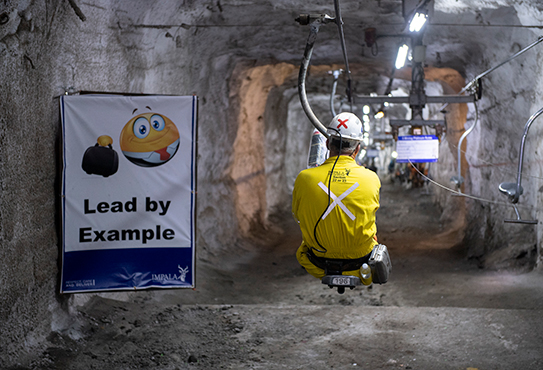
Our safety, health and wellbeing strategies aim to foster an operational culture that will help us achieve our vision of zero harm.
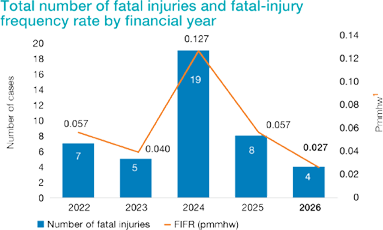
Number of fatal injuries: 4 (2025: 8)
2026 target: Zero fatalities
We also maintained an HIV suppression rate for employees receiving ART of greater than 95% (2025: >95%).
Eight-point safety plan
We continued to implement our eight-point safety plan to improve our safety performance, including a focus on ‘quick-win’ safety opportunities. It is being implemented across all our South African operations and the concept has been adopted by Zimplats. It places particular emphasis on underground safety controls, including blast on netting, in stope lighting, winch drum guards, proximity warning systems and remote train operations.

The health and wellbeing of our employees underpins everything we do and is fundamental to our ability to deliver safe, responsible and sustainable performance across our operations. We protect the health of our workforce through the day-to-day management of occupational health risks, disease prevention, structured health surveillance and a growing range of wellbeing initiatives.
Our conventional deep-level operations in South Africa present occupational health risks to our employees – including exposure to noise, dust and particulates – which require careful and ongoing management. In addition, South Africa and Zimbabwe experience high national incidence rates of communicable diseases, including HIV/Aids and tuberculosis, and our health programmes are designed and implemented with these realities in mind.
| Objective | Proposed milestone | Our response | Status |
| Reduction of overexposure to respirable crystalline silica dust | Not applicable1. | Not applicable | Not applicable |
|---|---|---|---|
| Reduction of overexposure to respirable coal dust | Not applicable2. | Not applicable | Not applicable |
| Reduction of overexposure to respirable platinum mine dust | By December 2034, 95% of all exposure measurement results will be below the milestone level for respirable platinum mine dust of 1.0mg/m3 (these results are individual readings and not average results, and the milestone will be reviewed in 2029 (after five years)). | See page 40 | In progress |
| Elimination of occupational lung diseases/pneumoconiosis | By December 2034, using current diagnostic techniques, no novice pneumoconiosis cases of silicosis, coal worker’s pneumoconiosis, and pneumoconiosis because of respirable platinum mine dust will occur among previously unexposed individuals. | See page 40 | In progress |
| Elimination of noise-induced hearing loss (NIHL) through quietening of equipment |
By December 2034, the noise emitted by individual pieces of equipment operated by employees and individual process equipment should not exceed a milestone sound pressure level of 104dB(A).
Using current diagnostic methods, by December 2034, there should be no novice cases of NIHL among previously unexposed individuals. |
See page 40 | In progress |
| Reduction and prevention of TB | By December 2034, the TB incidence rate of all commodities should be at or below the national TB incident rate. |
See page 40 Continuous monitoring of programmes to ensure performance is maintained |
Achieved |
| Reduction and prevention of HIV/Aids | 95% of employees should be offered HIV counselling and testing (HCT) annually, with all eligible employees linked to and retained on an antiretroviral therapy treatment (ART) programme as per the national strategic plan. |
See page 40 Continuous monitoring of programmes to ensure performance is maintained |
Achieved |
| Promotion and support of mental health of employees | 95% of employees screened annually for mental health and 100% of screened employees with mental health challenges to be linked to care (this includes in-house or referral) annually. | See page 41 | In progress |
| Prevention and management of non-communicable diseases (NCDs) | 100% of employees presenting during medical surveillance programme should be screened for NCD metabolic risk factors. |
See page 41 Continuous monitoring of programmes to ensure performance is maintained |
Achieved |
| 1 | By December 2034, 95% of all exposure measurement results will be below the milestone level for respirable crystalline silica dust of 0.03mg/m3 (these results are individual readings and not average results, and the milestone will be reviewed in 2029 (after five years)). |
| 2 | By December 2034, 95% of all exposure measurement results will be below the milestone level for respirable coal dust of 1.25mg/m3 (these results are individual readings and not average results, and the milestone will be reviewed in 2029 (after five years)). |
We have significantly increased our mental health screening capacity, including the expansion of self-referral pathways both online and in person, and have seen a marked rise in the number of employees screened and in referrals for mental health support.
Through awareness campaigns, workshops and open dialogue, mental health is becoming a topic that employees can talk about more openly and for which they can more readily access support. Counselling services are delivered through our medical department, providing first-line support and referring employees for specialist intervention where required.
Read more